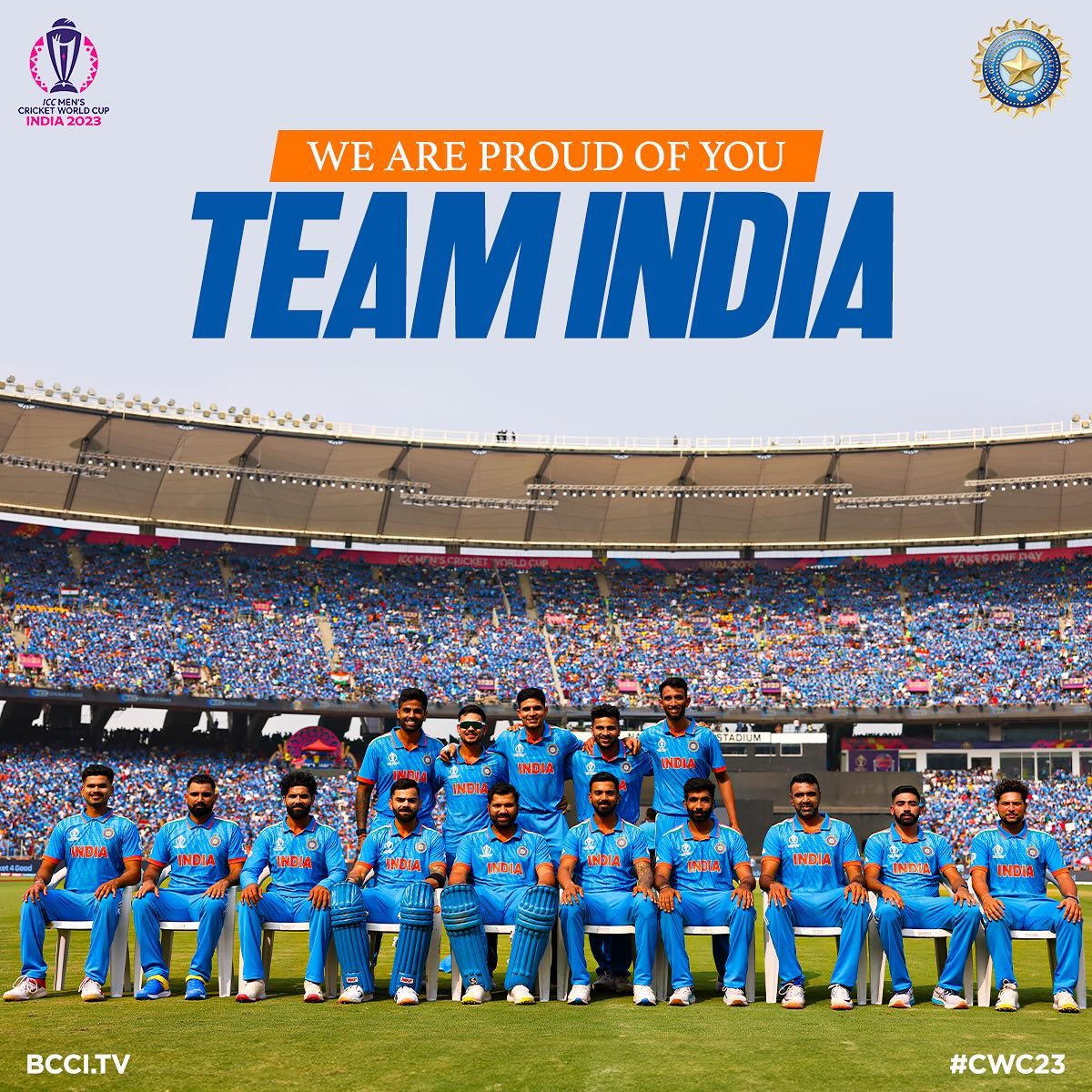
November 19 2023 was a day written in history as a billion cricket fans in India were heartbroken, felt sunken and ended their day with a loss @ 2023 Cricket World Cup final between India and Australia. Both teams are very worthy of taking the stage. But the game that India played in the season was way better than watching a season of Ted Lasso on Apple TV. Afterall, this was live sports and the fans witnessed something completely extraordinary from the team.
For context, the Cricket World Cup happens every 4 years since it started in 1975, India has only won the Cricket World twice, once by the Kapil Dev led team in 1983 and second by a Dhoni led team in 2011. These are 2 out of the 13 cups played from 1975 to 2023. In contrast, Australia has won the world cup 6 times. So, they were a very worthy opponent in 2023. However, today is all about the game Indian men in blue played in the 2023 season of Men’s Cricket World Cup (Further referred as CWC in the article. For more stats on Men’s Cricket World Cup, you can read up here: https://en.wikipedia.org/wiki/Cricket_World_Cup or use AI or Google!)
The 2023 Men’s Cricket World Cup
In total, 10 countries qualified for the CWC and in a new format, each team played 9 other team and only the top 4 played a knockout semi-final to qualify for the finals. Like any other sports season, there were all sorts of matches, some games were nail biters leaving you at the edge of your seat while others were one sided with new countries entering the world of ODI Cricket (Ex. Netherlands and Afghanistan). Every single team gave their best and some even proved the general fans of cricket wrong many times with their performance and won big hearts throughout the tournament. The rise in the quality of game of Afghanistan was one such story while the fall of Sri Lanka and Pakistan were a couple other examples. However, the game India played was magnificent as they remained undefeated throughout the tournament, until the grand finale. Cricket is a religion in India, the 2023 CWC was hosted by India and the finals brought the hopes and dreams of over a billion Indian fans crashing down faster than the fall of any stock exchange in 2022. Nonetheless, the team’s play in 2023 was every bit inspiration for the big small leaders in any industry as well as for the youth of today. None of this is new you can’t find in books but seeing it in action is very rare I must say.
The 2023 Men’s India Cricket team 2023
The 2023 Men’s Indian Cricket Team was led by Rohit Sharma (aka Sharmaji ka launda in my household) with Rahul Dravid as their head coach. Every single game India played in 2023 leading up to the finals was played with their minds and their team culture first and their skill sets came second. Every single one on the team was an inspiration. For the first time since watching Cricket as a child I applauded each player at various moments and not just a handful of popular heroes on the team which is usually the case in any team. This was also the first tournament after the pandemic. So the passion and love in the fans was another level. The team truly played as one and there were not “I” to be found in a single performance.Mistakes were made, players were injured and replaced. But every single game was a candy to the eyes – execution done just right and not a single win came “accidentally” or by luck. The team felt like 10 different manifestations of 1 Rohit Sharma, while Sharma stayed confident and humble throughout the game. Here’s what you can learn from the team if you are a leader:
Data for decisions + Judgment – Talk about making decisions using data and judgment – Sharma ji a launda, a Mumbaikar at heart, made each decision with tact and composure. Be it replacing Hardik Pandya with Mohammed Shami or in the field with Kohli losing a wicket early on telling KL Rahul to stay steady. This calm can only be achieved with practice, knowledge of your opponents, potential of your players and being honest about your weaknesses.
Hope is not a strategy – the team always had a plan and a contingency they constantly worked in parallel. Opposition was attached on multiple levels.
Each teammate carried their weight – You may be a top batsman but when Kohli was on the field, he kept eyes on all the ball and ran when needed and so did the others.
Tag teaming – it was a treat to watch 4 players standing on top of the batter and allowing them the headspace to think where they could hit.
Empowerment of the team – Even when the bowler was not sure, the wicketkeeper KL Rahul knew it was a wicket and while the umpire had given a not out originally, he called for a DRS without losing time to convince others. The captain trusted his judgment and gleefully reminded KL that review had to come from the captain. Also, when KL proved the skipper wrong on multiple accounts which the skipper accepted. Rohit relied on his team to guide him and vice versa.
Owning up to your mistakes – The time when Kuldeep Yadav took a wicket but was convinced by the umpire’s decision and later the skipper found that KD was right, he was told immediately to fix his error and was given a chance to fix it. Multiple errors were made while playing England and some other games. But the team constantly learned and adapted and the tight communication was very evident.
The Hero mindset – OR the lack of one hero mindset. Multiple members of the team broke various prior records. They were GOAT in their own right. This self aware team knew who to listen to in what situation as there were 11 heroes in the team, each with a very specific skill set. The team made decisions together and while there were individual feat achieved, it was never at the expense of the team.
Celebrating small wins – The most important and most unseen job on the field is off the fielder. The spotlight is usually on the bowler bowling and taking wickets or the batsman scoring big. So after each match, the team applauded the big fielding moments and picked the best fielder of the day. Afterall, no one likes doing a thankless job!
Leading with Example – Sharma, the skipper knew exactly his role in the team. And it was not to score individual records but to lead with example throughout. He knew his own strengths and was also the opening batsman. His job was not to get to his next 100 or 50. His job as an opener was to maximize on the powerplay and set the team up for success, for them to take a baton and be ready to run (literally and figuratively)
The Winning Mindset – All 10 games prior to the final, you can watch Team India step into the field with a winning mindset, undeterred by any situation that came up. This happened because each person knew every other teammate very well, they had the tools and skills to combat anything that came their way. Not a single person played “Hero” – they each believed and played like a part of the team. They trusted each other and they knew exactly the tactics to use against the top batters and bowlers of the opposing team. The team was empowered and every one was on the same page and of the same mindset. Each knew very well without a shred of doubt the part they were playing in the team. They were confident and knew what to do when asked to rise to the occasion. The one sided matches against Bangladesh and Sri Lanka were big examples of that while South Africa was actually the second best team in the tournament. All mighty opponents saw ONE TEAM while playing India and were visibly under pressure,putting them constantly on a defense. This was to me the BIGGEST learning of all. And this is exactly where I believe the team lost in the end.
The pressure mindset – It is one thing to be in the winning mindset and play your next game every single time. That’s what Rohit believed in and led the team with it. Afterall, they were playing on the home ground and they had the energy of over 100,000 people at any given stadium. However, this support was overshadowed in the final with the fear of letting down the hopes and dreams of your own billion people on your home ground. In a way, it was a self fulfilling prophecy where the country was saying “Rohit, you have our support and do your job and win this cup for us and please don’t let us down”. The team had played and won against Australia before and with a ‘winning mindset’ that game was a walk in the park. However, when you start feeling the weight of billions of dreams, it is hard to play yourself, with a winning mindset! The gremlins in your ears are every bit real and no matter what kind of resources you have at your disposal, you can’t shake out the doubt in your heart and mind. It is like a dark shadow that makes you question your skill. And make no mistake, the leader’s winning mindset of self doubt will percolate to the team, no matter how much it is unspoken/hidden.
In a way, today I as a fan let Rohit down! In a way, the pressure overpowered the team. In a way, everything is a mind game after all. All of this can happen to any of us. In fact, an average person is typically reacting to their surrounding fear and pressure at most times. We can all relate to things we have done under the pressure of our parents. Here, there were just too many of them. The team India journey was a great reflection of the human journey and how we should work everyday with our family as a one empowered fabric, be it home or work.
 Working Mom Musing
Leave a comment